 EN
EN

In modern crop production, the efficiency of soil preparation directly determines the quality of seedbed conditions, root development, and ultimately, yield outcomes. Among the various tillage implements available to farmers and agribusinesses today, the reversible plough has emerged as a highly practical solution for operations that demand consistent, high-quality soil inversion across diverse field conditions. The central question many crop producers ask is whether this implement genuinely enhances soil turning efficiency or whether its advantages are overstated relative to conventional alternatives.
The short answer is yes — a reversible plough can meaningfully enhance soil turning efficiency in crop production, but the degree of improvement depends on how it is matched to field geometry, soil type, tractor capacity, and operational workflow. This article examines the mechanisms behind that efficiency gain, the conditions under which a reversible plough performs best, and the practical considerations that crop producers should evaluate before integrating this implement into their tillage program.
Understanding How a Reversible Plough Works
The Core Mechanism of Soil Inversion
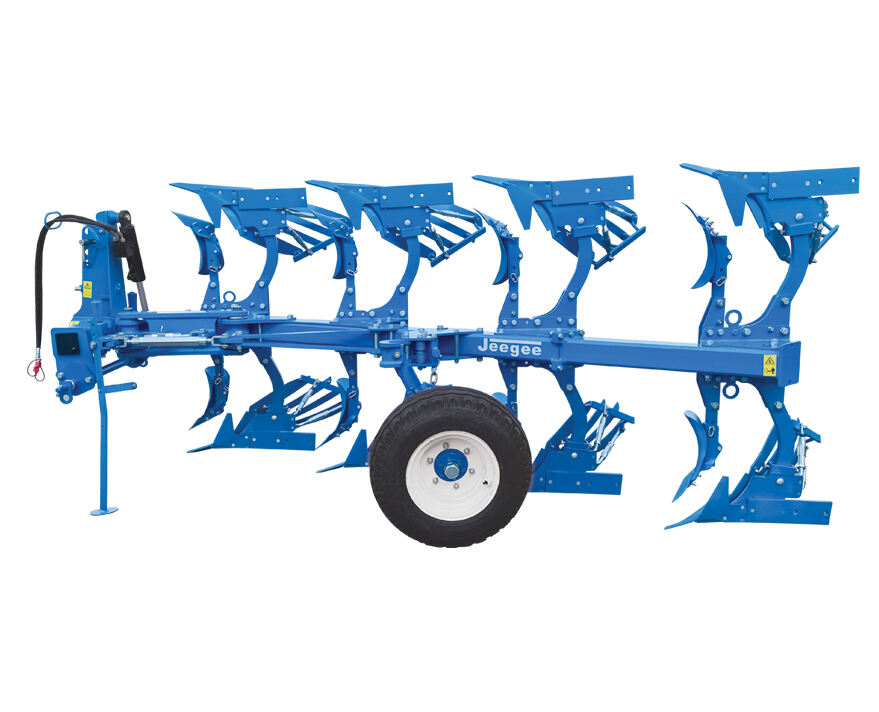
A reversible plough is designed with two sets of opposing plough bodies — one set configured to turn soil to the right and the other to the left. At the end of each field pass, the implement is hydraulically rotated so that the alternate set of bodies engages the soil on the return pass. This means the tractor always works in the same direction relative to the furrow wall, and soil is consistently turned in one direction across the entire field.
This bilateral inversion capability is the defining mechanical feature that separates a reversible plough from a conventional fixed-body plough. With a conventional plough, the operator must either work in a back-and-forth pattern that leaves a central ridge or adopt a more complex field pattern to avoid uneven soil displacement. The reversible plough eliminates this structural inefficiency by design.
The hydraulic rotation mechanism is typically controlled from the tractor cab, allowing the operator to switch plough orientation quickly at headlands without leaving the seat. This reduces turnaround time significantly, which is a direct contributor to overall field efficiency, particularly in large-scale crop production operations.
Furrow Quality and Soil Displacement Consistency
Beyond the mechanical rotation, the reversible plough is engineered to deliver uniform furrow depth and consistent soil slice geometry on every pass. The plough bodies — whether mouldboard, disc, or chisel variants — are matched in geometry so that both the right-hand and left-hand sets produce equivalent inversion quality. This symmetry is critical for achieving a level seedbed without ridges or depressions that would complicate subsequent field operations.
Consistent soil displacement also has agronomic implications. When crop residues, weed seeds, and surface organic matter are buried uniformly to a controlled depth, decomposition rates are more predictable, and the seedbed presented to the planter or drill is more homogeneous. This directly supports more uniform germination and stand establishment, which are foundational to efficient crop production.
Efficiency Gains Specific to Crop Production Workflows
Eliminating Dead Furrows and Back Furrows
One of the most tangible efficiency advantages of a reversible plough in crop production is the elimination of dead furrows and back furrows. These are the ridges and depressions left by conventional ploughs when soil is always turned in one direction. Dead furrows create low spots that collect water and impede drainage, while back furrows create raised ridges that interfere with planting equipment and irrigation uniformity.
In fields where precision planting is practiced — particularly for row crops such as maize, soybeans, or sugar beet — a level, ridge-free seedbed is not merely a cosmetic preference but a functional requirement. The reversible plough delivers this outcome as a standard result of its operating principle, not as an additional adjustment or compromise.
For crop producers managing fields with irregular shapes or significant headland areas, the ability to work without leaving structural soil disturbances translates into measurable time savings during subsequent field passes. Fewer corrective operations are needed before planting, which compresses the overall pre-planting window and reduces machinery hours per hectare.
Headland Efficiency and Field Utilization
Headland management is a frequently underestimated component of tillage efficiency. With a conventional plough, the operator must plan field patterns carefully to manage where ridges and furrows accumulate, often requiring additional passes along headlands to correct soil displacement. A reversible plough simplifies headland management because the implement turns soil consistently regardless of travel direction.
This simplification reduces the number of headland passes required and allows the operator to work closer to field boundaries without leaving unploughed strips or compacted zones. In crop production systems where every square meter of productive land matters, this improvement in field utilization has a direct economic value that compounds across a full growing season.
The reversible plough also supports more flexible field entry patterns, which is particularly useful when working around obstacles, drainage features, or irregular field boundaries. Operators can adapt their working direction without compromising soil inversion quality, giving them greater operational flexibility than a fixed-body implement allows.
Soil Type Suitability and Agronomic Conditions
Performance Across Different Soil Textures
The reversible plough performs effectively across a wide range of soil textures, from light sandy loams to heavier clay-dominant profiles. However, the specific plough body configuration — including the shape of the mouldboard, the angle of attack, and the working depth — should be matched to the dominant soil type in the field. Manufacturers typically offer multiple body options to accommodate this variation, and selecting the appropriate configuration is essential to realizing the full efficiency potential of the implement.
In heavy clay soils, a reversible plough with a more aggressive mouldboard curvature helps break up compacted layers and invert dense soil slices more completely. In lighter soils, a shallower, more gradual mouldboard profile reduces unnecessary soil pulverization and preserves aggregate structure. The reversible plough's efficiency advantage is most pronounced when the body geometry is correctly specified for the soil conditions encountered.
Soil moisture content at the time of ploughing also significantly influences efficiency outcomes. A reversible plough, like any inversion tillage implement, performs best when soil moisture is within the workable range — neither too dry and hard nor too wet and plastic. Operating outside this range increases draught requirements, reduces inversion quality, and can cause structural soil damage that negates the agronomic benefits of the operation.
Crop Residue Management and Burial Depth
Effective crop residue management is a key agronomic function of primary tillage, and the reversible plough is well suited to this task. By inverting the soil slice to a consistent depth, the implement buries surface residues beneath a layer of mineral soil, accelerating decomposition and reducing the risk of residue interference with planting equipment or seedling emergence.
In high-residue crop production systems — such as those following maize or sunflower — the reversible plough's ability to bury large volumes of organic material uniformly is a significant practical advantage. The consistent inversion geometry ensures that residues are not left partially exposed or concentrated in furrow bottoms, which would create uneven decomposition and potential disease carryover issues.
The reversible plough also supports weed seed burial as part of an integrated weed management strategy. By inverting the soil to a depth that places weed seeds below the germination zone, the implement contributes to reduced weed pressure in the subsequent crop without relying solely on herbicide inputs. This agronomic function adds value to the efficiency calculation beyond simple soil turning speed.
Tractor Requirements and Operational Considerations
Power and Hydraulic Capacity
A reversible plough places specific demands on the tractor that operates it. The hydraulic rotation mechanism requires adequate hydraulic flow and pressure from the tractor's auxiliary hydraulic system, and the overall draught load of the implement must be within the tractor's rated pulling capacity. Matching implement size — measured in number of furrows and working width — to available tractor power is a fundamental prerequisite for efficient operation.
Undersized tractors operating a reversible plough that exceeds their capacity will experience wheel slip, reduced working depth consistency, and increased fuel consumption per hectare — all of which erode the efficiency gains the implement is designed to deliver. Conversely, a well-matched tractor-implement combination allows the operator to work at optimal speed and depth, maximizing output per hour while maintaining inversion quality.
Full-suspension hydraulic reversible ploughs, which are mounted on the tractor's three-point linkage and fully supported by the hydraulic system during transport, offer additional advantages in terms of headland maneuverability and transport stability. This configuration is particularly well suited to medium and large tractors operating in commercial crop production environments where field efficiency and transport safety are both priorities.
Operator Skill and Setup Precision
The efficiency of a reversible plough is also influenced by the skill and attention of the operator during initial setup and field calibration. Correct adjustment of working depth, furrow width, and plough body alignment is essential to achieving consistent inversion quality across the full working width. An improperly set reversible plough can produce uneven furrow depths, incomplete soil inversion, or excessive soil disturbance beyond the intended working zone.
Modern reversible ploughs are designed with adjustment mechanisms that simplify the setup process, but operators still need to understand the relationship between plough geometry, soil conditions, and tractor settings. Investing time in proper calibration at the start of each ploughing season — and recalibrating when moving between fields with significantly different soil conditions — pays dividends in consistent performance and reduced wear on plough components.
Training and experience also contribute to headland efficiency. An experienced operator using a reversible plough can execute smooth, rapid turnarounds that minimize non-productive time at field ends. This operational proficiency, combined with the implement's mechanical advantages, is what allows the reversible plough to deliver its full efficiency potential in commercial crop production settings.
Economic and Agronomic Value in Commercial Crop Production
Cost per Hectare and Productivity Metrics
From a commercial crop production perspective, the efficiency of any tillage implement is ultimately measured in cost per hectare and the quality of the agronomic outcome it delivers. A reversible plough typically commands a higher initial investment than a comparable conventional plough, but this cost differential is offset by the productivity gains achieved through faster field completion, reduced corrective operations, and improved seedbed quality.
Operations that track machinery costs carefully will find that the reversible plough's higher utilization rate — more productive hectares per hour due to simplified field patterns and faster headland turns — reduces the effective cost per hectare over time. When this is combined with the agronomic value of a more uniform seedbed and better residue management, the total return on investment for the implement becomes compelling in most commercial crop production contexts.
The reversible plough also reduces the need for secondary tillage passes to correct surface irregularities left by conventional ploughing. Fewer passes mean lower fuel consumption, reduced soil compaction from repeated machinery traffic, and a shorter pre-planting preparation window — all of which contribute positively to the overall economics of the crop production system.
Long-Term Soil Health Considerations
While the reversible plough is primarily an efficiency tool, its consistent inversion action also has implications for long-term soil health management. By burying surface organic matter and crop residues to a controlled depth each season, the implement supports the gradual incorporation of organic carbon into the soil profile, which contributes to improved soil structure and water-holding capacity over time.
However, crop producers should be aware that intensive annual inversion tillage with a reversible plough can, over many years, disrupt soil biological communities and reduce the concentration of organic matter in the upper soil horizon if residue inputs are insufficient to compensate for burial losses. Integrating the reversible plough into a broader soil health management strategy — including cover cropping, organic matter additions, and periodic soil testing — ensures that short-term efficiency gains do not come at the expense of long-term soil productivity.
The reversible plough is best understood as a high-performance primary tillage tool that delivers maximum value when used strategically, matched to appropriate conditions, and supported by sound agronomic management. In that context, it is a genuine asset to efficient and productive crop production operations.
FAQ
Is a reversible plough suitable for all field sizes in crop production?
A reversible plough delivers the greatest efficiency advantages in medium to large fields where the elimination of dead furrows and simplified headland management translate into meaningful time savings. In very small or irregularly shaped fields, the efficiency gains may be less pronounced, but the implement still delivers superior seedbed quality compared to conventional fixed-body ploughs. Field size should be considered alongside soil type and tractor capacity when evaluating suitability.
How does a reversible plough differ from a conventional mouldboard plough in terms of soil turning quality?
A reversible plough produces a consistently level, ridge-free surface because it inverts soil in the same direction on every pass, regardless of travel direction. A conventional mouldboard plough always turns soil to one side, creating back furrows and dead furrows that leave the field surface uneven. For crop production systems that require a uniform seedbed, the reversible plough delivers a measurably higher quality outcome with fewer corrective operations needed afterward.
What tractor power range is typically required to operate a reversible plough effectively?
The required tractor power depends on the number of furrows and the working width of the reversible plough. Smaller two- to three-furrow models can be operated effectively with tractors in the 60–90 horsepower range, while larger four- to six-furrow implements typically require 120–200 horsepower or more. Matching implement size to available tractor power is essential for achieving consistent working depth and maximizing fuel efficiency per hectare.
Can a reversible plough be used in conservation tillage systems?
A reversible plough is primarily a full inversion tillage implement and is not typically classified as a conservation tillage tool. However, it can be used strategically within a broader rotation that includes reduced tillage or cover cropping phases. Some crop producers use a reversible plough periodically to address compaction, manage heavy residue loads, or reset soil structure, while relying on minimum tillage practices in intervening seasons. This integrated approach allows producers to capture the efficiency benefits of the reversible plough without committing to intensive annual inversion tillage.
Table of Contents
- Understanding How a Reversible Plough Works
- Efficiency Gains Specific to Crop Production Workflows
- Soil Type Suitability and Agronomic Conditions
- Tractor Requirements and Operational Considerations
- Economic and Agronomic Value in Commercial Crop Production
-
FAQ
- Is a reversible plough suitable for all field sizes in crop production?
- How does a reversible plough differ from a conventional mouldboard plough in terms of soil turning quality?
- What tractor power range is typically required to operate a reversible plough effectively?
- Can a reversible plough be used in conservation tillage systems?